Japanese Sweet Rolled Omelet (Tamagoyaki) — Atsuyaki Tamago
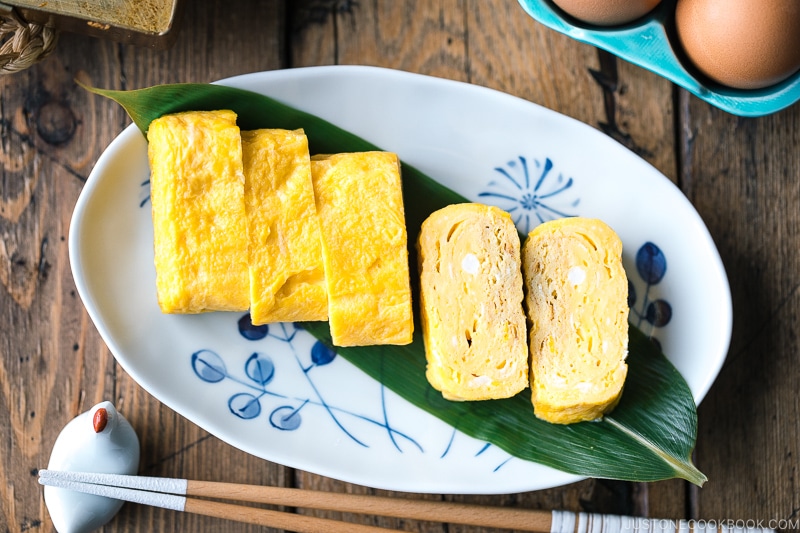
Learn how to make my recipe for beautiful Japanese Sweet Rolled Omelet (Atsuyaki Tamago) from thin layers of fried egg seasoned with dashi, soy sauce, and sugar. Enjoy this delicious and versatile tamagoyaki side dish for breakfast, bento lunch, or a standalone snack!
Ingredients
3 servings
Instructions
- Gather all the ingredients for the sweet dashi and rolled omelette.
- In a small saucepan, combine 1¼ cups dashi (Japanese soup stock) and ½ cup sugar.
- Add 1½ tsp soy sauce and 2 tsp Diamond Crystal kosher salt. Turn the heat to medium and mix well together.
- When the sugar is dissolved, turn off the heat and transfer into a mason jar. Let cool completely before closing the lid. Store in the refrigerator for up to a week or freeze it in batches. For example, my tamagoyaki pan requires 4 eggs and 4 Tbsp sweet dashi, so I'd freeze 4 Tbsp portions of sweet dashi. You can also use an ice cube tray to freeze it.
- In a bowl or a liquid measuring cup with a handle, combine 4 large eggs (50 g w/o shell) and 4 Tbsp sweet dashi (1 Tbsp of sweet dashi per large egg). Depending on the size of your tamagoyaki pan (or frying pan), adjust the number of eggs.
- Using chopsticks, break the egg yolks and whisk to combine with the whites, but don't overbeat. It should have a thick and elastic consistency.
- Please remember: 1) The pan must be hot when you add the egg mixture; otherwise, it will stick. 2) To adjust the heat, lift and move the pan away from or toward the heat source. 3) Use your arms and shoulders to move the pan toward you and roll the egg, instead of using just your wrist. It gives you better control and momentum. 4) Only the final layer matters for the look. Don't worry about small tears and holes until the final layer. Make sure to maintain a good shape throughout cooking, as the final layer can't hide an irregular shape. 5) Make 4–6 layers for a rectangular tamagoyaki pan and 2–3 layers for a round pan.
- Heat the tamagoyaki pan over medium heat. Add 2 Tbsp neutral oil to a small bowl. Grease the bottom and sides of the pan with a folded paper towel soaked in oil. Make sure to wipe off any excess oil. Test the pan to see if it's hot enough: Dip chopsticks in the egg mixture and touch the tips to the frying pan. If the egg sizzles, the pan is ready. Note: I once tried to use a silicone brush instead of a paper towel, but it left excess oil that created an unpleasant look on the omelette with lots of small holes/bubbles.
- The 1st layer: Pour in just enough egg mixture to cover the cooking surface. Pop the air bubbles with chopsticks and tilt the pan to fill the holes with excess egg mixture.
- When the egg is just set (the mixture is not runny but not cooked through), run your chopsticks along the edges to detach the egg from the pan's sides. Then, roll the egg toward you, starting from the far edge. If you use chopsticks, lift the frying pan toward you in a rolling motion to create momentum that will help you roll the eggs. If you use a spatula, you may need to occasionally remove the pan from the heat so the bottom doesn't get too hot.
- Once you've finished rolling up the omelette to the side closest to you, grease the bottom and sides of the pan with the paper towel soaked in oil (remember to remove any excess).
- Move the omelette to the far edge and grease the bottom and sides that you just uncovered. Test the pan again with a bit of the egg mixture. If it sizzles, the pan is hot enough.
- The 2nd layer: When the pan is ready, pour in just enough egg mixture to cover the cooking surface. Tilt the pan and lift the rolled omelette so some of the egg mixture goes underneath it.
- Pop the air bubbles with chopsticks and tilt the pan to fill up the holes with excess egg. When the egg is just set, run your chopsticks along the edges to detach to egg.
- Roll the omelette toward you again. Once you've finished, grease the bottom and sides again. Move the omelette to the far edge. Grease the pan again and test to see if it's hot enough.
- The 3rd layer: Repeat cooking another layer of the egg mixture. You can create momentum with the pan using your arm and shoulder to roll the egg as it gets heavier.
- The 4th layer: Repeat cooking another layer of eggs. When the pan is hot, pour in the egg mixture and tilt some of it underneath the rolled egg. Pop the air bubbles, detach from the edges, and start rolling.
- The final/outer layer: Grease the bottom and sides again. Add the remaining egg mixture, lift up the rolled omelette, and pop the air bubbles. Carefully roll the final layer. This is the outer layer, so make sure not to break it.
- Shape the rolled egg, pushing
- Wrap the rolled omelet in a bamboo sushi mat for 5 minutes.
- Open the sushi mat and cut the rolled omelet in half.
- Then cut each half into 3 equal pieces. Serve immediately or at room temperature. Optionally, you can serve with grated daikon drizzled with soy sauce.
- You can keep the leftovers in an airtight container and store them in the refrigerator for up to 2–3 days and in the freezer for 2 weeks.
Nutrition per serving
Protein9g
Carbs7g
Fat13g
177kcal
9gProtein
7gCarbs
13gFat
💰 Cost Estimate
Total Ingredients
$174.00
$174.00
Per Serving
$58.00/serving
$58.00/serving
🏠 Savings
~$348.00 vs buying!
~$348.00 vs buying!
📋 Price Breakdown (86% ingredients detected)
| Ingredient | Amount | Subtotal |
|---|---|---|
| large eggs | 4 | $131.00 |
| sweet dashi | 4 tbsp | $16.00 |
| neutral oil | 2 tbsp | $8.00 |
| dashi | 1.25 cups | - |
| sugar | 0.5 cup | $7.00 |
| soy sauce | 1.5 tsp | $8.00 |
| Diamond Crystal kosher salt | 2 tsp | $4.00 |
*Estimated market prices, may vary by region
Recipe Assistant
Ask anything about this recipe




Comments
Loading comments...